
News & Events

SK Chemicals Achieves Korea's First Vertical Integration in Recycling via Raw Material Internalization
October 25,2025
-
Targeting plant operation by H2 2026; Securing price competitiveness through internalizing raw material sourcing.
-
SK Chemicals implements Korea’s first vertical integration of the recycling value chain.
SK Chemicals (CEO Ahn Jae-hyun) announced on the 10th that it will establish a joint venture with Kelinle, a plastic recycling specialist based in Shanxi Province, China, to construct the "Feedstock Innovation Center (FIC)," a dedicated waste plastic processing facility.
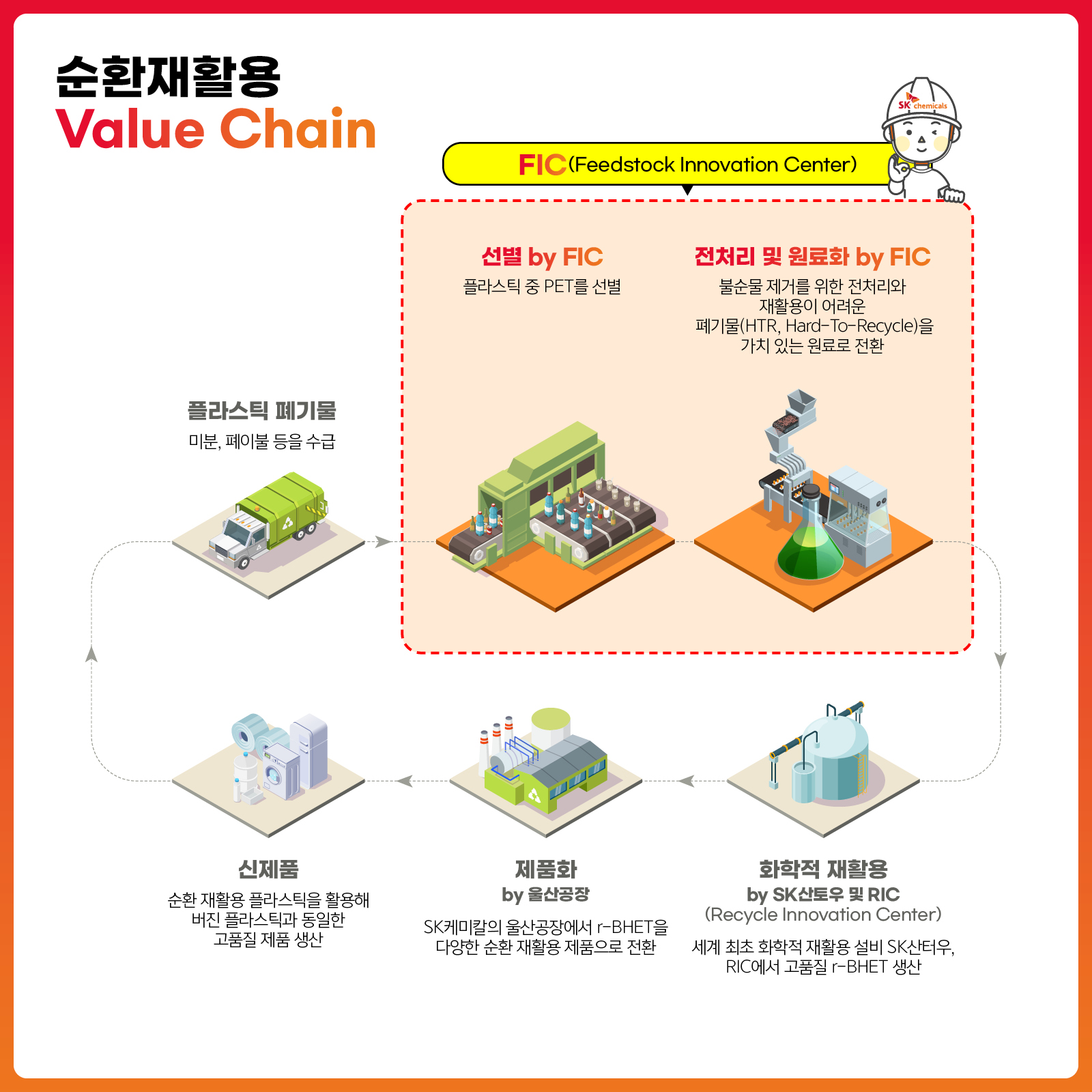
The FIC will be responsible for processing waste plastic into raw materials. Upon completion, SK Chemicals will secure a comprehensive value chain that spans from waste plastic sourcing to the production of chemically recycled materials. SK Chemicals is the first Korean chemical company pursuing chemical recycling (such as depolymerization) to establish a legal entity equipped with its own waste plastic sourcing facilities.
The two companies plan to build a process to produce recycled feedstock on a 13,000-square-meter idle site owned by Kelinle in Weinan, Shanxi Province. Kelinle, which has operated in the local plastic recycling business for 10 years, will leverage its local network to procure raw materials. SK Chemicals will then use its technical expertise to pre-treat these materials and produce PET pellets, a recycled raw material.
Differentiating Feedstock: From Discarded Bedding to Micro-particles
Unlike mechanical recycling companies that primarily use PET bottles, the FIC is designed to convert discarded blankets (bedding) and fine particles (fines)—generated during the PET bottle crushing process—into feedstock for chemical recycling. Starting with an initial production of approximately 16,000 tons, the facility plans to expand capacity to 32,000 tons per year to supply most of the raw materials required by SK Shantou.
Securing Stable Supply and Cost Competitiveness
The company expects the establishment of the FIC to be a turning point in significantly expanding the competitiveness and stability of its "circular recycling" plastic business, which is being fostered as a future growth engine.
In SK Chemicals' depolymerization-based circular recycling process, waste plastic acts as the fundamental raw material, much like crude oil. Therefore, securing a stable supply of waste plastic at low prices is a critical foundation for the business.
Typically, recycled plastic producers purchase feedstock from external vendors, leaving them vulnerable to price volatility and supply instability based on market conditions. As global regulations mandating the use of recycled materials tighten, the industry expects the shortage and rising cost of waste plastic to intensify.
Establishing an internal sourcing system is expected to resolve supply uncertainties and further enhance cost competitiveness. The primary materials handled by the FIC were previously incinerated because they were difficult to recycle; consequently, they can be procured at a lower cost compared to transparent PET bottles. SK Chemicals analyzes that once the FIC is fully operational, it will secure supply stability and reduce raw material costs by approximately 20%.
Environmental Impact and Technical Superiority
The project also promises significant waste reduction by repurposing discarded blankets that were previously incinerated or landfilled. Approximately 4.6 million tons of bedding are discarded globally each year, with a recycling rate of less than 1%.
While discarded blankets are cost-effective to procure compared to clear PET bottles, they require high-level technology to be converted back into raw materials, which is why commercialization has been rare. However, based on its world-first commercialized depolymerization technology, SK Chemicals can successfully upcycle difficult-to-recycle waste such as fibers, fluff, and colored PET bottles.
Unlike physical recycling, which involves crushing and melting plastic, the depolymerization process returns waste to its molecular state. This allows for repeated recycling without quality degradation and offers superior hygiene compared to physical methods.
"Through the FIC, we have secured a complete recycling value chain that connects raw material sourcing to depolymerization and material production," said Ahn Jae-hyun, CEO of SK Chemicals. "The cost competitiveness gained by upcycling difficult waste like discarded blankets will help break down the price barriers of recycled plastics, which are currently higher than petroleum-based materials."
Meanwhile, SK Chemicals established a chemical recycling production entity in Shantou, China, in 2023, creating a global hub for the commercial production of r-BHET and CR-PET. In Korea, the company has built a Recycle Innovation Center (RIC) at its Ulsan plant to link depolymerization pilots with co-polyester production while accumulating expertise in recycling banners and textile waste.